
MULTIPLE INTELLIGENCE
- Michael Smith
- Oct 9, 2024
- 5 min read
Updated: Oct 17, 2024
Unlock Your Full Potential
Michael F Smith, LPC, MS, MA, MBA
Introduction
As an executive coach, I often encounter clients who struggle to fully understand their strengths, sometimes limiting their potential by viewing intelligence through a narrow lens. Traditionally, intelligence has been quantified by IQ tests, emphasizing a singular, standardized measure of cognitive ability. However, in 1983, Harvard psychologist Howard Gardner revolutionized our understanding of intelligence by proposing Theory of Multiple Intelligences, highlighting that human cognitive ability is far more diverse and multifaceted than previously believed. He originally conceived of seven differing intelligences, but in later years, Gardner introduced two more intelligences—Naturalistic Intelligence (added in 1995) and Existential Intelligence (considered but not officially confirmed as part of his framework). These additions came as Gardner continued to explore the diversity of human cognitive abilities.
Gardner’s theory suggests that there are various ways individuals process information, solve problems, and thrive in different domains. This perspective opens the door for personal growth, helping people identify areas of strength and improve areas needing development. Whether you're navigating a career change, fostering leadership qualities, or deepening personal development, understanding these nine types of intelligence can offer critical insights for leveraging your unique talents.
In this article, we will explore Gardner's nine types of intelligence, discuss how they manifest in real-world scenarios, and offer actionable strategies for enhancing each type.
Summary of Gardner's Nine Intelligences:
Linguistic Intelligence: The ability to use language effectively, both in spoken and written forms.
Logical-Mathematical Intelligence: A capacity for logical reasoning, pattern recognition, and problem-solving.
Spatial Intelligence: The skill to visualize and manipulate objects mentally.
Musical Intelligence: Sensitivity to sound, rhythm, pitch, and melody.
Bodily-Kinesthetic Intelligence: The control over physical movement and handling objects skillfully.
Interpersonal Intelligence: The ability to understand and interact with others.
Intrapersonal Intelligence: A deep awareness of one's own emotions, motivations, and thought processes.
Naturalistic Intelligence: The ability to recognize and classify plants, animals, and natural elements.
Existential Intelligence: A tendency to contemplate life’s fundamental questions and philosophical issues.
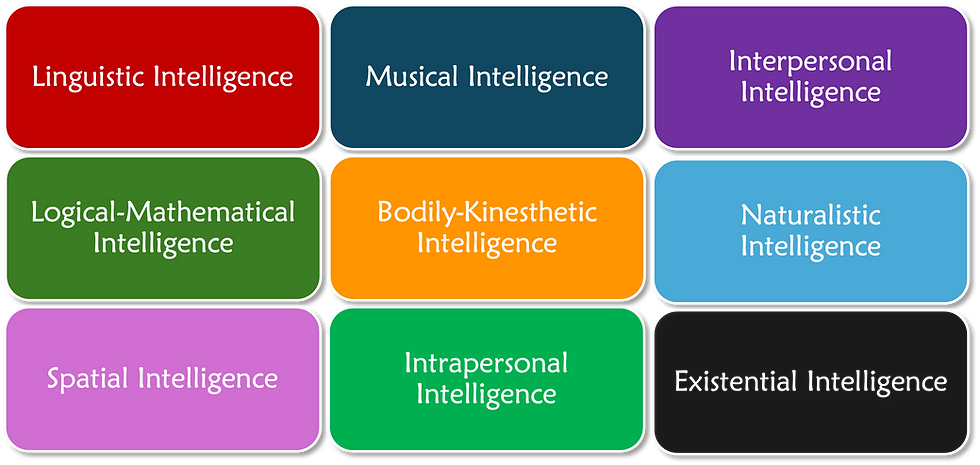
Exploring the Nine Types of Intelligence
1. Linguistic Intelligence: Mastery of Words and Communication
People with strong linguistic intelligence are natural communicators, excelling in both written and spoken language. This intelligence is common in writers, poets, teachers, journalists, and lawyers who thrive in roles requiring verbal expression. In leadership, this ability allows for articulate communication, persuasive presentations, and effective storytelling—a critical skill in inspiring teams and influencing decision-makers.
2. Logical-Mathematical Intelligence: Logic, Patterns, and Numbers
Individuals with logical-mathematical intelligence are adept at reasoning, problem-solving, and working with numbers. This intelligence is crucial for mathematicians, engineers, and analysts who can break down complex systems into understandable patterns. Leaders with this intelligence are exceptional at strategic planning, forecasting, and making data-driven decisions.
3. Spatial Intelligence: Visualization and Design
Those with spatial intelligence can visualize objects, designs, and environments mentally, excelling in fields like architecture, graphic design, and engineering. They often display a strong sense of direction and creativity in visualizing abstract concepts. This type of intelligence is vital for careers that involve building, planning, or working with visual elements.
4. Musical Intelligence: Sensitivity to Sound
Musical intelligence refers to an individual’s sensitivity to sounds, rhythms, and melodies. People strong in this intelligence are natural musicians, composers, and sound engineers, often using their auditory skills to produce or enjoy music. In leadership, this intelligence can aid in fostering creativity, collaboration, and emotional resonance within teams.
5. Bodily-Kinesthetic Intelligence: Physical Coordination and Dexterity
Athletes, dancers, surgeons, and craftsmen often possess strong bodily-kinesthetic intelligence, excelling in tasks requiring physical control and precise movements. Leaders with this intelligence may excel in physical tasks or hands-on activities and often embody a strong presence or charisma, which can influence others through physical demonstration or action.
6. Interpersonal Intelligence: Empathy and Social Connection
Interpersonal intelligence is the ability to understand and interact with others effectively. It involves empathy, social awareness, and strong communication skills. Leaders with high interpersonal intelligence are adept at team building, conflict resolution, and motivating others—skills essential in roles that require collaboration, negotiation, and people management.
7. Intrapersonal Intelligence: Self-Awareness and Emotional Insight
Intrapersonal intelligence refers to a deep understanding of one’s own emotions, motivations, and strengths. Leaders with strong intrapersonal intelligence are often introspective, self-regulating, and emotionally resilient, qualities that are crucial for personal development, self-mastery, and long-term success.
8. Naturalistic Intelligence: Connection to Nature
Individuals with naturalistic intelligence are attuned to nature and excel in recognizing patterns in the natural world. This intelligence is often seen in botanists, environmentalists, and biologists. Leaders with this intelligence are likely to be passionate about sustainability and environmental initiatives, bringing a balanced perspective on ecological concerns.
9. Existential Intelligence: Contemplation of Life’s Big Questions
Existential intelligence involves the ability to ponder deep questions about life, existence, and morality. Individuals strong in this intelligence, such as philosophers and spiritual leaders, are often drawn to abstract thinking and ethical dilemmas. Leaders who exhibit existential intelligence are visionaries, capable of inspiring others through their deep understanding of purpose and meaning.
How to Assess and Cultivate Your Intelligences
Gardner's multiple intelligences can be assessed through various tools and activities, ranging from verbal reasoning tests for linguistic intelligence to musical aptitude tests for musical intelligence. While these assessments aren't as standardized as traditional IQ tests, they offer valuable insights into one's cognitive strengths and areas for development.
In the context of personal and professional growth, understanding your dominant intelligences allows you to craft strategies for success that align with your natural strengths. For instance, a leader with strong interpersonal intelligence might focus on developing stronger communication channels within their organization, while someone with high logical-mathematical intelligence might excel in roles involving data analysis or problem-solving.
Conclusion
Gardner’s Theory of Multiple Intelligences offers a transformative way of thinking about human potential. As an executive coach, I encourage you to reflect on your own unique blend of intelligences and consider how you can harness them to advance your career, lead effectively, and achieve personal mastery. The power lies in recognizing that intelligence is not a fixed measure but a dynamic set of abilities that, when nurtured, can lead to greater fulfillment and success in all areas of life.
FAQs
Understanding your multiple intelligences can help you leverage your strengths to lead more effectively, whether it’s through communication, problem-solving, or team building.
Can you develop multiple intelligences over time?
Yes, while everyone has natural inclinations toward certain intelligences, most can be developed and refined through practice and learning.
What careers align with each type of intelligence?
Careers such as writing (linguistic), engineering (logical-mathematical), and architecture (spatial) align well with specific intelligences, but every career can benefit from a mix of intelligences.
How do I identify my dominant intelligence?
You can identify your dominant intelligence through self-assessments, reflection, and seeking feedback on what activities come naturally and where you excel.
Is one intelligence more important than the others?
No single intelligence is more important than another; each contributes uniquely to our ability to navigate different aspects of life and work. The goal is to recognize and cultivate a balanced approach to leveraging all intelligences.
Michael F Smith is a licensed professional counselor and an executive coach and consultant who brings his unique background and experiences in his private practice, Innerventure Counseling LLC.


Comments